§ Case study · BeeSpeaker · 2025—2026

A language-learning app with 5M+ downloads. Two parallel roles in one year — leading product design across the app, and owning the web funnel from zero.
§ 01 Context
What I walked into.
The product had real scale, but the research, design rigour, and the web funnel were not yet anchored. My job was to bring enterprise discipline without slowing the team down — startup speed, enterprise depth.
§ 02 What I owned
Three things I owned.
End-to-end product design — hypothesis-driven. Owned the design process from discovery to ship, anchored in hypotheses and measured against analytics. Decisions framed as questions to test, not guesses to defend.
Product Owner. Feature ownership. Acted as Product Owner on the web funnel initiative — vision, backlog, cross-functional delivery. Regularly led feature workstreams as the design owner inside small focused teams.
Owning the research roadmap. Owned the research roadmap — what to study, when, and how. Led most studies myself, and delegated where the team could move faster on their own.
§ 03 — Story 01 · The web funnel
Building a new acquisition channel — as Product Owner.
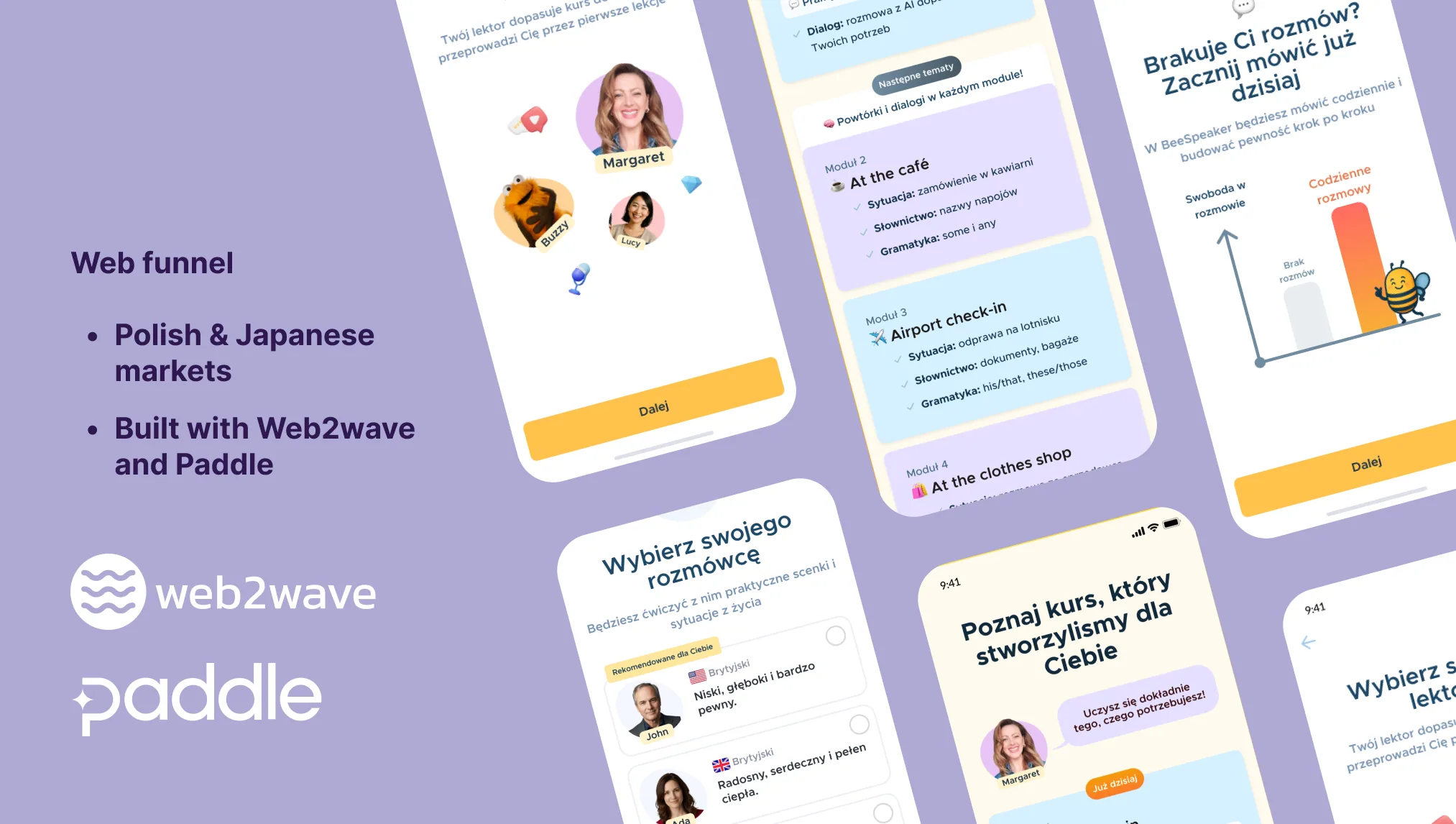
Build BeeSpeaker's first web acquisition funnel — using Web2wave — and lead both an internal team and the external software partner.
Grow acquisition and remarketing through competitor research, hypothesis-driven design, and A/B testing across several markets.
Competitor and trend research. Full design process across all screens, with hand-off to dev. Ongoing iteration based on test results. Localization across markets with the team.
Coordinated work across engineering, marketing, content, and agile ceremonies. Set strategy for what to build and change next. Owned analytics and reporting.
Funnel launched in Polish and Japanese markets — now part of BeeSpeaker's acquisition stack. Strong working rhythm across internal team and external partner. Framework set for future market launches.
§ 04 — Story 02 · The AI Tutor
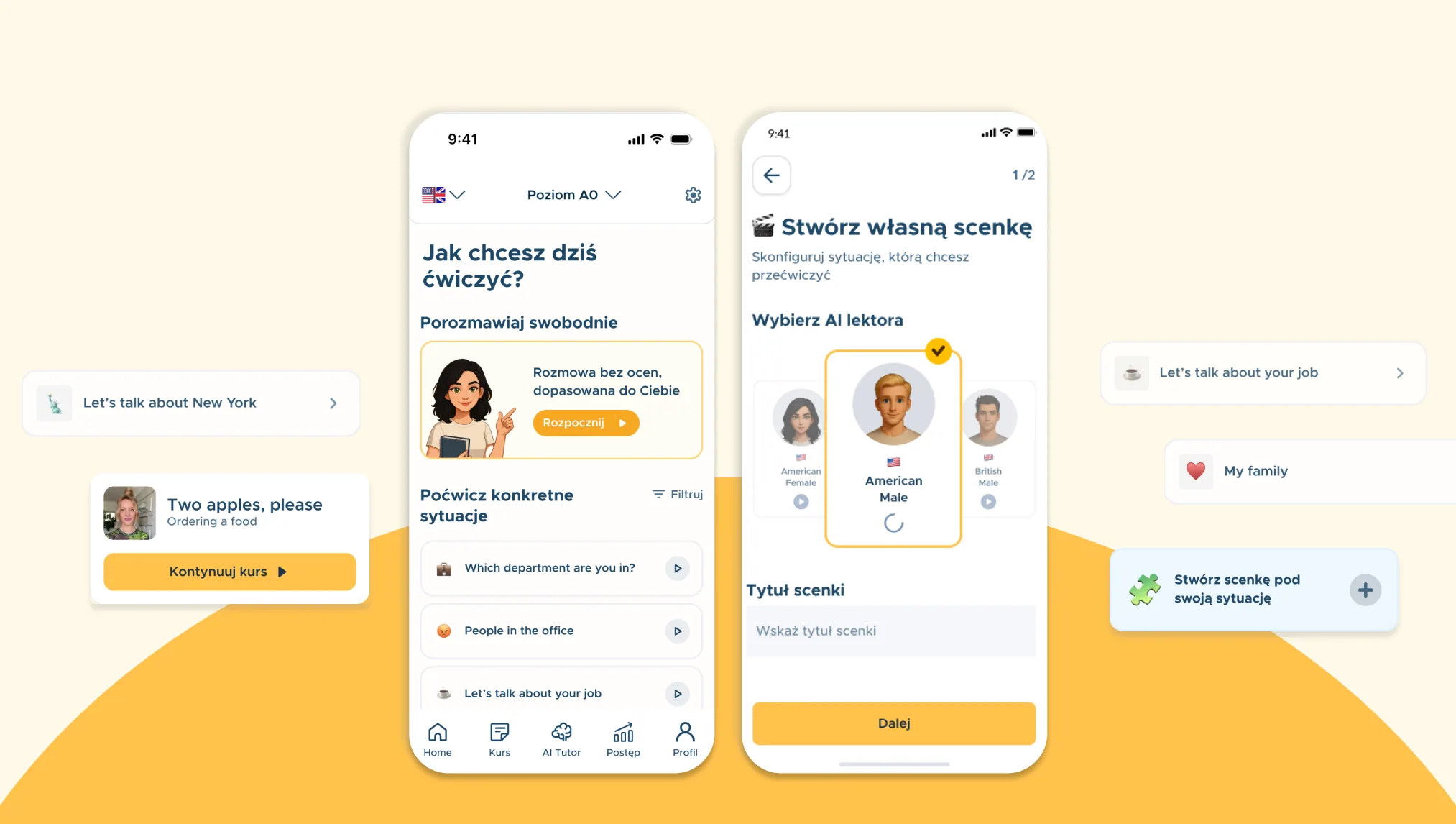
AI Tutor — from empty chat to guided practice.
The Free Talk feature felt like an empty chat. High entry barrier, no clear starting point, no way to filter or create custom scenarios.
Redesign the entry point so users always know what to do next, can find the right scenario fast, and feel confident to start.
The process, step by step.
-
01 · Research
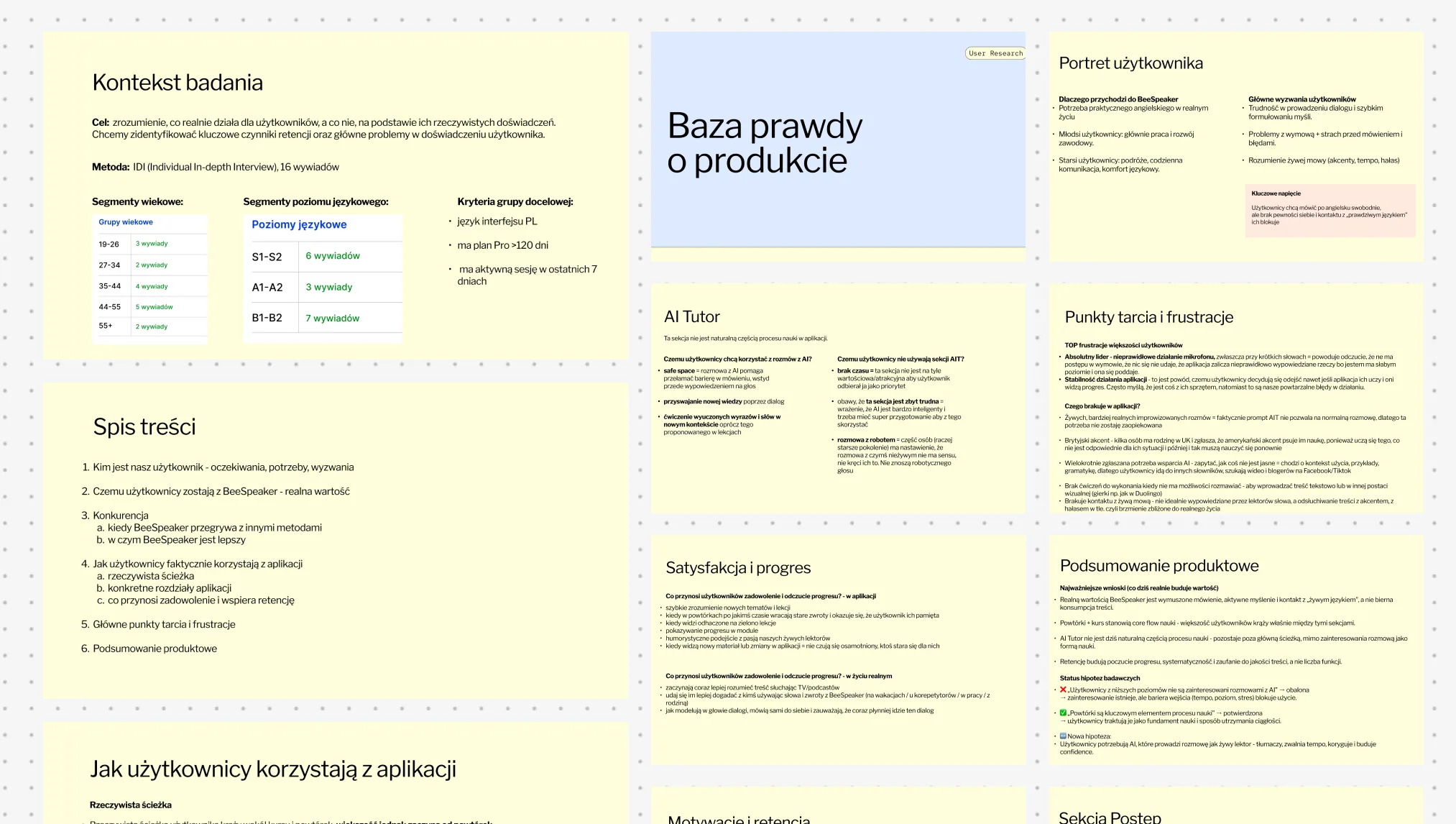
Designed and ran an in-depth study called "Product Ground Truth" — focused on how users really experience BeeSpeaker, with the AI Tutor as the main lens.
- Defined a scenario and recruitment criteria: active Pro users with 120+ days in the product
- Conducted 16 IDI sessions across 5 age groups and 3 language levels
- Analysed each interview in FigJam with AI support extracting patterns from recordings
- Synthesised findings into a report and presented to the full team
-
02 · Hypothesis canvas
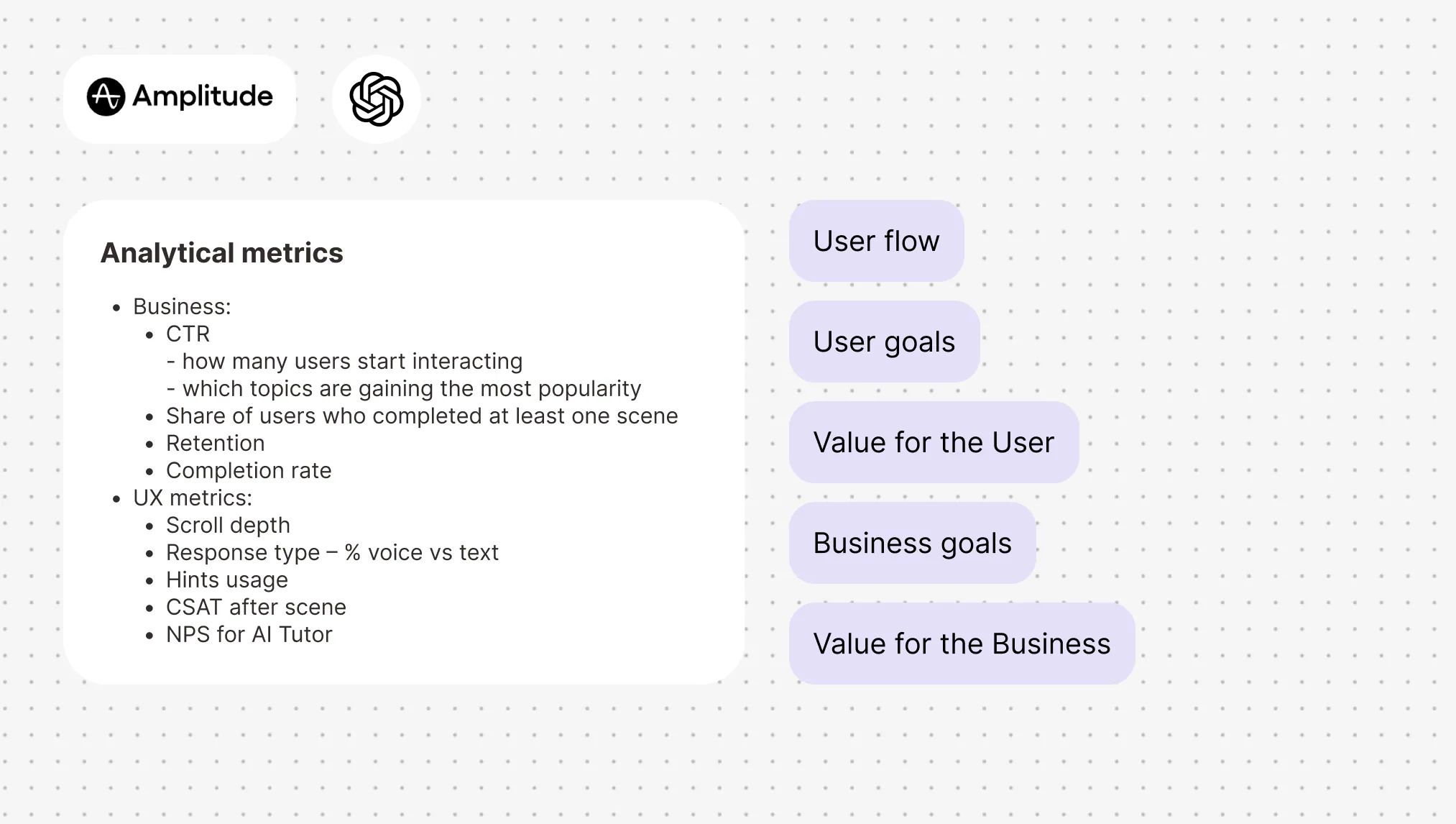
For each screen I built a hypothesis canvas — business goals, user goals, analytics metrics, value for business, value for user.
Metrics were anchored in Amplitude — measurable, trackable, and tied to A/B tests. The canvas became the foundation for every PM conversation and shifted the team from "what should we build" to "what are we testing."
-
03 · Screen-level documentation
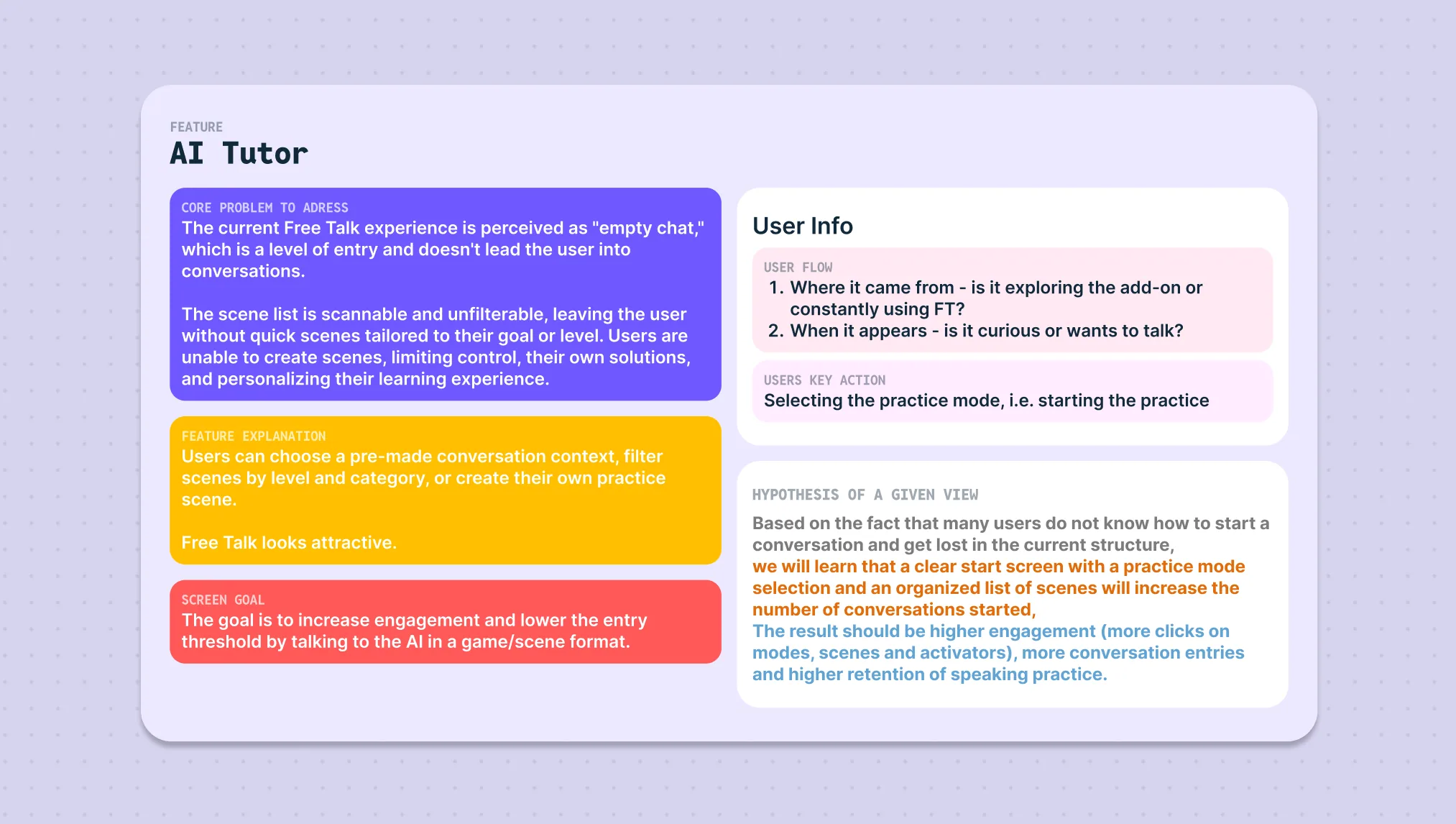
For each major screen I built a structured brief: core problem to solve, solution concept, view goal, user flow with key action, and a testable hypothesis.
This kept the team aligned on every screen — what we were solving, what we were testing, and what success looked like before any pixels were drawn.
-
04 · Low-fi with risk mapping
Worked through low-fi variants with the team, mapping risks directly onto wireframes — each variant paired with an explicit hypothesis to test:
- Cognitive overload from too many options on one screen
- Unclear hierarchy between conversation and scenarios
- Missing entry points for less confident users (A1–A2 levels)
- Scenario library competing with primary actions
-
05 · Refinement and final UI
Refined the direction in a live design session with the team — turning the strongest low-fi into a tighter medium-fi the team could challenge together. Used AI as a working partner for copy variations and UI exploration, then aligned everything with plain language principles and A/B test plans.
Final delivery included:
- Final layout placed in the full app flow context
- Analytics events defined for each interaction
- Implementation documentation in Figma and Jira for the dev team
- Clear entry point: two primary ways to start practice (open conversation or custom scenario), with the scenario library as a filterable support layer below
§ 05 Reflection
Four things I carry forward from BeeSpeaker:
- Building research strategy and owning the roadmap from scratch.
- Leading cross-functional teams when the pace doesn't slow down.
- Generating product decisions under pressure without losing rigour.
- And the conviction that AI can guess what users want — real conversations show what they actually do.
Next case
Nationale-Nederlanden
European insurance & investment group · 1M+ users · 2022—2025
Read case study →